_edited.png)
Loka Lalitha Ambika
Yantras & Sadhanas
.png)
.png)
.png)
.png)
.png)


Dus Mahavidya Devis

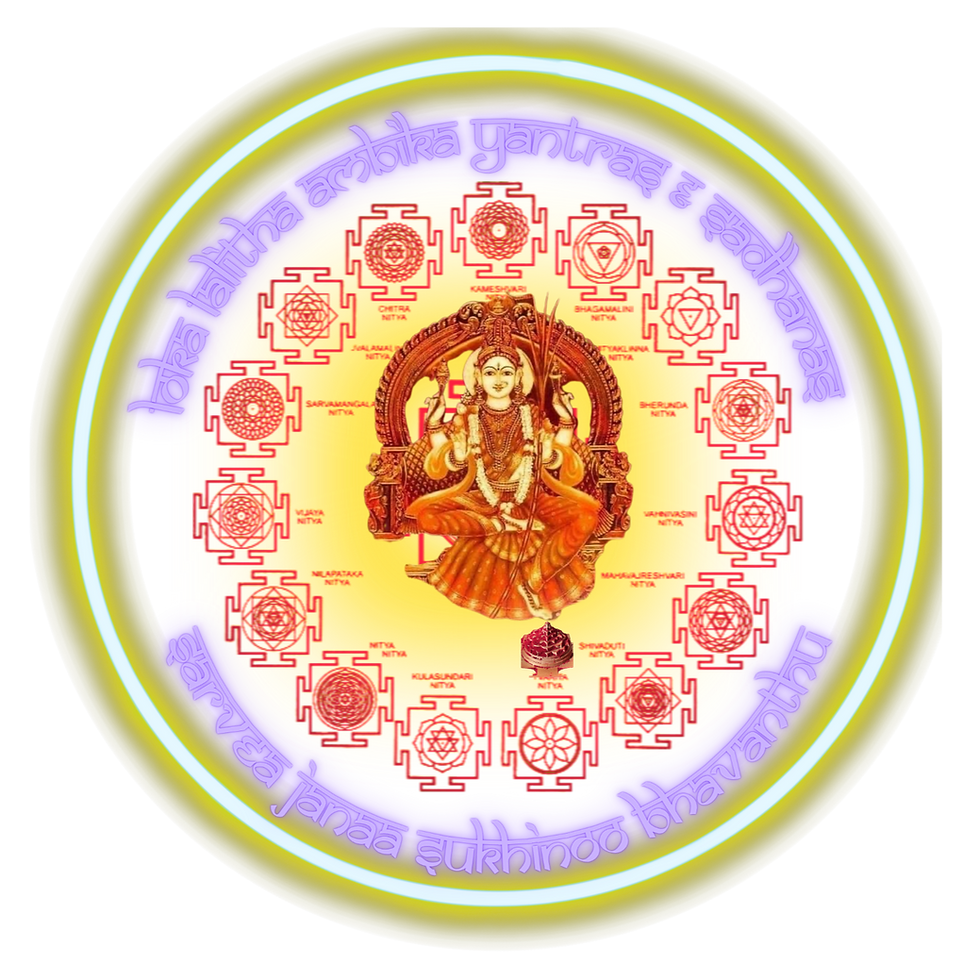
Śrī Lalitā Tripura Sundarī Ambigai — The Supreme Śrī Vidyā Mahāśakti

Śrī Lalitā Tripura Sundarī—revered as the crown jewel of the Daśa Mahāvidyās—is the embodiment of Paraśakti in her most refined, सौन्दर्य (divine beauty) and blissful (ānanda) form. She is called “Tripura Sundarī” because she transcends and beautifies the three realms (physical, subtle, causal) and the three states of consciousness (jāgrat, svapna, suṣupti). As Śrī Vidyā Devī, she resides in the mystical Śrī Chakra (Śrī Yantra), seated on the throne of the five Brahmas (Brahmā, Viṣṇu, Rudra, Īśvara, Sadāśiva), symbolizing that even the highest cosmic functions arise from her. Her radiance (tejas) is described as a fusion of rising sun, lightning, and molten gold—yet softened by मातृभाव (motherly compassion). She holds the pāśa (attachment), aṅkuśa (control), sugarcane bow (mind), and five flower arrows (five tanmātras)—indicating her mastery over desire, mind, and manifestation.
Her śakti is not merely destructive or protective—it is creative, harmonizing, and fulfillment-granting (pūrṇatā-pradāyinī). Lalitā blesses devotees primarily based on śuddha bhāva (pure intention), mantra śuddhi, and guru-kr̥pā rather than mere ritual precision. She responds deeply to those who approach her through Śrī Vidyā upāsanā, especially with the Pañcadaśī or Ṣoḍaśī mantras. Her grace (anugraha) manifests as inner सौन्दर्य (spiritual elegance), आकर्षण (divine magnetism), wealth (both material and subtle), ज्ञान (wisdom), and पूर्ण कामना सिद्धि (fulfillment of righteous desires). Unlike fierce Mahāvidyās, she grants blessings through saukhya (comfort), सौम्यता (gentleness), and सौभाग्य (auspiciousness)—making her path both royal (Rāja Yoga) and deeply tantric.
The benefits of her sādhana are considered among the highest in Tantra: Śrī (prosperity), Aishvarya (sovereignty), Vāk Siddhi (speech perfection), Kāma Siddhi (desire fulfillment), and ultimately Mokṣa (liberation). Her sādhanas are broadly known as Śrī Vidyā Sādhana, which includes:
Mantra Sādhana (Pañcadaśī, Ṣoḍaśī)
Śrī Chakra Pūjā / Navāvaraṇa Pūjā
Kuṇḍalinī-based internal worship (Antaryāga)
Mānasa Pūjā (mental worship)
Rāja Rājeśvarī Upāsanā (royal devotional path)
Her primary consort is Kāmeśvara (Śiva in his highest आनंद form), and their union represents the non-duality of Śiva (pure consciousness) and Śakti (creative power). Unlike conventional duality, Lalitā is often seen as supreme—even Kāmeśvara acts through her will, symbolizing that Śakti is the dynamic aspect of Brahman. In Śrī Vidyā, she is also surrounded by divine retinues like Mantriṇī (Śyāmalā) and Daṇḍinī (Vārāhī)—not merely consorts but extensions of her icchā (will), jñāna (knowledge), and kriyā (action) śaktis. This multi-layered divine relationship structure reflects that the entire cosmos operates as her divine administration (Śrī Nagara).
In essence, Lalitā Tripura Sundarī is not just worshipped—she is experienced as the very आनंद (bliss), सौन्दर्य (beauty), and पूर्णता (completeness) of existence itself.
That you are truly eligible to undertake Śrī Lalitā Tripura Sundarī Ambigai Sādhana as per your Kuṇḍali and spiritual maturity?
That your current stage of life supports such an intense and energy-transforming sādhana?
Do You Truly Spiritually Know ?
That this sādhana is genuinely the need of the hour for you, or is it driven by curiosity, attraction, or impulse?
That you have the required discipline, mental steadiness, and control over senses to handle prāṇa-śakti at this level?
That you are prepared for the inner shifts, detachment, and ego-transformation that this path demands?
That you have proper Guru guidance and protection before stepping into such an advanced Mahāvidyā sādhana?
That your intention is aligned with dharma, or are you seeking quick results without understanding the depth?
Do not just guess your way into the spiritual path. Before stepping into any advanced sadhana, get proper clarity and guidance from Guru Shri Anant Dev Ji.
🔶 Get a FREE consultation with Guru Ji:
Fill out the Free Consultation Form Click Here
Send your details via Email @lokalalithaambikayantras@gmail.com OR Connect directly on WhatsApp +91-930-927-1927
“Your Sādhana Should Be Aligned, Not Assumed.”
Śrī Kālī Ambigai — The Primordial Mahāśakti of Time & Transformation
Śrī Kālī Ambigai, the first among the Daśa Mahāvidyās, is the ādi-śakti of kāla (time), pralaya (dissolution), and transcendence beyond all limitation. Her very name “Kālī” comes from kāla—meaning both time and death, indicating that she is the force that devours even time itself. Unlike the सौम्य (gentle) beauty of Lalita Tripura Sundari, Kālī represents the raw, unfiltered reality of existence—beyond illusion (māyā), beyond ego, beyond fear. She is depicted as digambarī (clothed in space), dark as the infinite void, dancing in the cremation ground (śmaśāna), wearing a garland of skulls (representing cycles of birth-death and letters of creation), with her tongue extended—symbolizing ego annihilation and the shock of awakening. Standing upon Shiva, she signifies that even pure consciousness becomes dynamic only through Śakti—yet her stepping on Śiva also represents the moment where absolute power recognizes its own stillness.
Her śakti is ugra (fierce), kṣipra (immediate), and utterly transformative. Kālī does not gradually refine—she cuts, burns, and dissolves impurities instantly. She blesses devotees not on outer ritual perfection, but on absolute surrender (ātma-samarpana), fearlessness, and readiness for inner death (ego dissolution). Those who approach her with half-hearted intent often feel intensity, while true sādhakas experience instant karmic cleansing, protection from unseen forces, and awakening of kuṇḍalinī. Her grace (kṛpā) manifests as abhaya (fearlessness), removal of black magic/obstacles, destruction of enemies (internal & external), and liberation from repetitive life patterns. Unlike other deities who grant desires first, Kālī often removes the very desire-root itself, leading the devotee toward mokṣa through direct confrontation with reality.
The benefits of her sādhana are powerful and non-linear: kāla-jaya (mastery over time influences), śatru-nāśa (enemy destruction), rakṣaṇa (protection), vāk siddhi, and ultimately nirvikalpa awareness (beyond mind). Her sādhanas fall under Kālī Tantra / Kaula Mārga / Vāmācāra and Dakṣiṇācāra variations, including:
Dakṣiṇā Kālī Upāsanā (controlled, sattvic-tantric worship)
Smashāna Kālī Sādhana (cremation-ground practices for advanced sādhakas)
Kālī Mantra Japa (e.g., Krīm bīja-based mantras)
Pañcatattva-based Kaula Sādhana (advanced and guru-dependent)
Kuṇḍalinī Awakening through Kālī Nyāsa & Prāṇāyāma
Mānasa Pūjā (internal fierce visualization practices)
Her primary consort is Mahākāla (Śiva beyond time), indicating the union of timeless awareness and time-devouring power. In many depictions, she stands on Shiva to show that Śakti is the active force, while Śiva is the silent witness—together forming the complete non-dual reality. Unlike more “royal court” structures seen in Śrī Vidyā, Kālī’s entourage includes bhūtas, yoginīs, ḍākinīs, and kṣetrapālas, symbolizing her dominion over liminal realms, spirits, and hidden dimensions of existence. She is also associated with forms like Dakṣiṇā Kālī, Smashāna Kālī, Bhadra Kālī, and Guhya Kālī, each representing different intensities of transformation and protection.
In essence, Śrī Kālī is not merely worshipped for blessings—she is entered as a path of total transformation. Where Lalitā gives divine fulfillment, Kālī gives divine emptiness that contains everything. She is the महामाता who may appear terrifying, but for the true devotee, she is the fastest doorway to liberation, शक्ति, and absolute fearlessness.
That You are truly eligible to undertake Śrī Kālī Ambigai Sādhana as per your Kuṇḍali and spiritual maturity?
That your current stage of life supports such an intense and energy-transforming sādhana?
Do You Truly Spiritually Know ?
That this sādhana is genuinely the need of the hour for you, or is it driven by curiosity, attraction, or impulse?
That you have the required discipline, mental steadiness, and control over senses to handle prāṇa-śakti at this level?
That you are prepared for the inner shifts, detachment, and ego-transformation that this path demands?
That you have proper Guru guidance and protection before stepping into such an advanced Mahāvidyā sādhana?
That your intention is aligned with dharma, or are you seeking quick results without understanding the depth?
Do not just guess your way into the spiritual path. Before stepping into any advanced sadhana, get proper clarity and guidance from Guru Shri Anant Dev Ji.
🔶 Get a FREE consultation with Guru Ji:
Fill out the Free Consultation Form Click Here
Send your details via Email @lokalalithaambikayantras@gmail.com OR Connect directly on WhatsApp +91-930-927-1927
“Your Sādhana Should Be Aligned, Not Assumed.”

Śrī Tripura Bhairavī Ambigai — The Fire of Tapas & Divine Discipline
Śrī Tripura Bhairavī, one of the central Daśa Mahāvidyās, is the embodiment of tapas-śakti (the power of intense spiritual fire), discipline, and transformative austerity. She is called “Tripura Bhairavī” because she governs and purifies the three worlds and three states of consciousness through the blazing force of inner साधना (sādhanā). While Kali represents sudden destruction and Lalita Tripura Sundari represents divine सौन्दर्य and fulfillment, Bhairavī stands as the bridge—she is the शक्ति that compels, disciplines, and prepares the साधक to become worthy of higher realization. Her form radiates deep red (rakta varṇa), symbolizing rāga (intensity), śakti (life-force), and agni (spiritual fire). She is often depicted with a serene yet commanding expression, holding japa mālā and scriptures, indicating that true power arises from sustained mantra, knowledge, and तपस्—not impulse.
Her śakti is niyama-pradhāna (discipline-centered), kṣobha-jananī (agitator of inner inertia), and karma-śuddhi-kārī (purifier of actions). Bhairavī does not immediately grant comfort—she forces alignment. She blesses devotees based on consistency (niyamit sādhana), sincerity, and willingness to endure tapas without deviation. Those who invoke her sincerely experience a powerful internal restructuring: removal of आलस्य (laziness), clarity in direction, awakening of kuṇḍalinī through controlled ascent, and sharpening of willpower (icchā śakti). Her grace (anugraha) manifests as focus, discipline, तेजस् (radiance), mantra siddhi, and the ability to sustain long-term sādhanā without collapse. Unlike Kālī who destroys instantly, Bhairavī burns slowly and steadily, ensuring that transformation is stable, grounded, and irreversible.
The benefits of her sādhana are especially vital for serious practitioners: mantra siddhi, tapas siddhi, vāk śuddhi (purity and power of speech), karma alignment, removal of भ्रम (confusion), and preparation for higher Śrī Vidyā realization. Her sādhanas are known under Bhairavī Tantra / Tripura Bhairavī Upāsanā, including:
Bhairavī Mūla Mantra Japa (often with hrīm or aiṁ-hrīm-śrīm combinations)
Yantra Pūjā (Bhairavī Yantra / Śrī Chakra integration)
Agni-based rituals (homa, internal अग्नि ध्यान)
Kuṇḍalinī Sādhana with disciplined चरण (stage-wise ascent)
Mānasa Pūjā focused on internal fire and red प्रकाश visualization
Dakṣiṇācāra and mixed Tantric-Vedic structured worship
Her consort is Bhairava (the fierce aspect of Shiva), symbolizing the union of uncompromising awareness and disciplined शक्ति. Unlike the cosmic stillness of Śiva or the आनंद of Kāmeśvara, Bhairava represents alert, penetrating consciousness that cuts through भ्रम and distraction. Together, Bhairavī–Bhairava represent the perfect alignment of will (icchā), knowledge (jñāna), and action (kriyā) in a sādhaka’s life. Her association with yoginīs and internal अग्नि further emphasizes that she governs the middle path of transformation—where energy is neither suppressed nor chaotic, but perfectly directed.
In essence, Śrī Bhairavī Ambigai is the Guru-Śakti within Tantra—the one who tests, refines, and ultimately empowers the साधक to hold higher energies without टूटन (collapse). If Kālī is the shock and Lalitā is the fulfillment, Bhairavī is the process—the sacred fire that makes both possible. She is the देवी who turns effort into siddhi, discipline into radiance, and साधना into an unbreakable spiritual force.
That you are truly eligible to undertake Śrī Tripura Bhairavī Ambigai Sādhana as per your Kuṇḍali and spiritual maturity?
That your current stage of life supports such an intense and energy-transforming sādhana?
Do You Truly Spiritually Know ?
That this sādhana is genuinely the need of the hour for you, or is it driven by curiosity, attraction, or impulse?
That you have the required discipline, mental steadiness, and control over senses to handle prāṇa-śakti at this level?
That you are prepared for the inner shifts, detachment, and ego-transformation that this path demands?
That you have proper Guru guidance and protection before stepping into such an advanced Mahāvidyā sādhana?
That your intention is aligned with dharma, or are you seeking quick results without understanding the depth?
Do not just guess your way into the spiritual path. Before stepping into any advanced sadhana, get proper clarity and guidance from Guru Shri Anant Dev Ji.
🔶 Get a FREE consultation with Guru Ji:
Fill out the Free Consultation Form Click Here
Send your details via Email @lokalalithaambikayantras@gmail.com OR Connect directly on WhatsApp +91-930-927-1927
“Your Sādhana Should Be Aligned, Not Assumed.”

Śrī Tārā Ambigai —
The Savior, Sound-Śakti & Compassionate Guide Across the Void
Śrī Tārā Ambigai, the second among the Daśa Mahāvidyās, is the tāraṇa-śakti—the power that “carries across” (tārayati) the ocean of saṁsāra. She is the Śabda-Brahman in dynamic form, the living current of mantra, nāda, and vāk that rescues the seeker from fear, ignorance, and existential संकट. While Kali embodies time’s annihilation and Tripura Bhairavi embodies tapas and disciplined fire, Tārā is the guiding voice in the void—the compassionate, immediate responder who grants protection and direction when the sādhaka feels lost. Iconographically she is nīla (deep blue/teal), digambarī, standing on inert Shiva, holding a khaḍga (sword), kapāla (skull-cup), scissors/knife, and blue lotus—symbols of cutting ignorance, drinking/transmuting poison, severing bondage, and blossoming wisdom. As Nīla Sarasvatī, she fuses knowledge (vidyā) with raw transformative power, making her both fierce and profoundly nurturing.
Her śakti is kṣipra-prasādinī (swiftly responsive), rakṣaṇa-pradhānā (protective), and vāk-siddhi-dāyinī (bestower of speech power). Tārā answers where there is śaraṇāgati (sincere surrender), mantra-śuddhi, and a genuine call for guidance or protection. She is especially invoked in crisis, fear, travel (inner/outer), occult disturbances, and states of confusion. Her grace (anugraha) manifests as sudden clarity, correct timing, safe passage through dangers, stabilization of prāṇa, and activation of mantra as living force. Unlike Kālī who may dissolve the situation, Tārā guides you through it—often by aligning your speech, breath, and mind. Devotees commonly experience dream-guidance, inner voice refinement, and heightened intuition under her upāsanā.
The fruits of her sādhana are both protective and initiatory: rakṣaṇa from visible/invisible threats, vāk siddhi (eloquence, mantra potency), jñāna-prakāśa (illumined understanding), nāda-anusandhāna (inner sound realization), and progressive kuṇḍalinī awakening with safety. Her principal streams of practice include:
Tārā Mantra Japa (notably bījas like oṁ hrīṁ strīṁ hūṁ phaṭ, lineages vary)
Nīla Sarasvatī Upāsanā (for learning, articulation, occult knowledge)
Ugra Tārā / Ekajaṭā Sādhana (advanced, guru-dependent, protection & breakthrough)
Tārā Yantra Pūjā (often integrated with Śrī Chakra for balanced ascent)
Prāṇāyāma & Nāda Sādhana (breath–sound synchronization, ajapa-japa)
Mānasa Pūjā (visualizing the blue प्रकाश guiding across inner voids)
Dakṣiṇācāra to Kaula approaches depending on adhikāra (eligibility)
Her consort is Akṣobhya (a still, unshakable form of Shiva)—the immovable awareness that allows Tārā’s rescuing current to operate without distortion. In some Tantric mappings she is also paired with Nīlakaṇṭha Śiva, emphasizing her role in transmuting poison (viṣa) into nectar (amṛta)—psychologically, this is the alchemy of fear, trauma, and भ्रम into wisdom and compassion. Her retinue includes ḍākinīs, yoginīs, and mantra-devatās, indicating her governance over liminal spaces, mantra-fields, and subtle sound currents. This is why Tārā is central to traditions that emphasize śabda (sound) as the primary doorway to realization.
In essence, Śrī Tārā Ambigai is the living bridge between terror and trust, silence and sound, confusion and clear direction. If Kālī is the void and Lalitā is the fullness, Tārā is the boat, the mantra, and the guiding current that carries the sādhaka safely across. She does not merely protect—she teaches you how to navigate, transforming your very speech, breath, and awareness into instruments of liberation (mokṣa) and empowered living (siddhi).
That you are truly eligible to undertake Śrī Tārā Ambigai Sādhana as per your Kuṇḍali and spiritual maturity?
That you are truly eligible to undertake Śrī Lalitā Tripura Sundarī Ambigai Sādhana as per your Kuṇḍali and spiritual maturit
Do You Truly Spiritually Know ?
That you are truly eligible to undertake Śrī Lalitā Tripura Sundarī Ambigai Sādhana as per your Kuṇḍali and spiritual maturit
That you are truly eligible to undertake Śrī Lalitā Tripura Sundarī Ambigai Sādhana as per your Kuṇḍali and spiritual maturit
That you are truly eligible to undertake Śrī Lalitā Tripura Sundarī Ambigai Sādhana as per your Kuṇḍali and spiritual maturit
That you are truly eligible to undertake Śrī Lalitā Tripura Sundarī Ambigai Sādhana as per your Kuṇḍali and spiritual maturit
That you are truly eligible to undertake Śrī Lalitā Tripura Sundarī Ambigai Sādhana as per your Kuṇḍali and spiritual maturit
That you have proper Guru guidance and protection before stepping into such an advanced Mahāvidyā sādhana?
That you are truly eligible to undertake Śrī Lalitā Tripura Sundarī Ambigai Sādhana as per your Kuṇḍali and spiritual maturit
That you are truly eligible to undertake Śrī Lalitā Tripura Sundarī Ambigai Sādhana as per your Kuṇḍali and spiritual maturit
That your intention is aligned with dharma, or are you seeking quick results without understanding the depth?
Do not just guess your way into the spiritual path. Before stepping into any advanced sadhana, get proper clarity and guidance from Guru Shri Anant Dev Ji.
🔶 Get a FREE consultation with Guru Ji:
Fill out the Free Consultation Form Click Here
Send your details via Email @lokalalithaambikayantras@gmail.com OR Connect directly on WhatsApp +91-930-927-1927
“Your Sādhana Should Be Aligned, Not Assumed.”

Śrī Rāja Mātaṅgī Ambigai —
The Sovereign of Vāk, Music & Inner Command
Śrī Rāja Mātaṅgī Ambigai, one of the most esoteric among the Daśa Mahāvidyās, is the embodiment of vāk-śakti (the sovereign power of speech), art, music, knowledge-expression, and subtle influence. She is often understood as the tantric counterpart of Saraswati, yet far more mystical, boundary-transcending, and commanding. As “Rāja Mātaṅgī,” she is not merely knowledge—she is the queen who governs how knowledge is expressed, received, and obeyed. Her form is typically śyāma/harita (emerald-green or dark bluish-green), seated on a royal throne, holding the vīṇā (cosmic harmony), pāśa, aṅkuśa, and sometimes a parrot (vāg-vāhinī, carrier of speech). Unlike purely sattvic forms, Mātaṅgī also accepts what is considered ucchiṣṭa (leftover/impure)—symbolizing that she transforms all rejected, hidden, or marginalized energies into refined wisdom and power.
Her śakti is ākarṣaṇa (attraction/influence), vāk-siddhi (speech mastery), and saṅkalpa-siddhi through expression. Mātaṅgī does not operate through force like Kali or through austerity like Tripura Bhairavi—she works through resonance, articulation, and subtle command. She blesses devotees based on clarity of intent, truthfulness in speech, disciplined mantra-japa, and refinement of expression (vāṅmaya śuddhi). When pleased, her grace manifests as eloquence, persuasive authority, musical/creative genius, success in public life, and the ability to influence minds without coercion. Importantly, she governs inner dialogue as much as outer speech—so her sādhana restructures how one thinks, speaks, teaches, negotiates, and commands reality through words and sound.
The benefits of her sādhana are uniquely suited for both spiritual and worldly excellence: vāk siddhi (speech that manifests), sarva-jana-vaśya (harmonious influence over people), kalā-sampat (arts mastery), medhā (intelligence), and mantra-caitanya (mantra becoming living force). Her sādhanas are known as Mātaṅgī Tantra / Rāja Mātaṅgī Upāsanā, including:
Mūla Mantra Japa (commonly with aiṁ hrīṁ śrīṁ clusters; lineage-specific)
Rāja Mātaṅgī Pūjā (royal mode within Śrī Vidyā frameworks)
Ucchiṣṭa Mātaṅgī Sādhana (advanced—transformative use of “rejected” energies; strictly guru-guided)
Vīṇā / Nāda Sādhana (music, sound, and rhythm as direct upāsanā)
Yantra Pūjā (Mātaṅgī Yantra; integration with Śrī Chakra)
Mānasa Pūjā (visualizing emerald radiance governing speech and thought)
Dakṣiṇācāra to Kaula approaches depending on adhikāra
Her consort is a form of Śiva as Mātaṅga or Mātaṅga-Śiva—a symbolism that pure consciousness expresses itself through articulated knowledge and culture. In some Śrī Vidyā mappings, she stands within the divine court (Śrī Nagara) of Lalita Tripura Sundari as a ministerial/intellectual शक्ति, alongside other powers like Śyāmalā and Vārāhī—indicating her role in governing communication, strategy, and cultural order of the cosmos. Her association with the parrot (śuka) highlights repetition (japa), transmission of knowledge, and precise articulation—all essential for mantra siddhi and real-world influence.
A distinctive and often misunderstood aspect of Mātaṅgī is her acceptance of ucchiṣṭa. Esoterically, this means she grants mastery over what society rejects—unrefined thoughts, taboo energies, suppressed desires—by transforming them into refined vāk and creative power. Thus, she is a deity of integration, not suppression. She teaches that nothing is outside the scope of Śakti; everything can be elevated through correct awareness and mantra.
In essence, Śrī Rāja Mātaṅgī Ambigai is the queen of articulated reality—the शक्ति through which thought becomes word, word becomes influence, and influence becomes manifestation. If Tārā is the guiding sound and Lalitā is the fulfilled beauty, Mātaṅgī is the commanding voice that shapes destiny—granting the sādhaka not just knowledge, but the authority to express, transmit, and rule through it.
That you are truly eligible to undertake Śrī Rāja Mātaṅgī Ambigai Sādhana as per your Kuṇḍali and spiritual maturity?
That your current stage of life supports such an intense and energy-transforming sādhana?
Do You Truly Spiritually Know ?
That this sādhana is genuinely the need of the hour for you, or is it driven by curiosity, attraction, or impulse?
That you have the required discipline, mental steadiness, and control over senses to handle prāṇa-śakti at this level?
That you are prepared for the inner shifts, detachment, and ego-transformation that this path demands?
That you have proper Guru guidance and protection before stepping into such an advanced Mahāvidyā sādhana?
That your intention is aligned with dharma, or are you seeking quick results without understanding the depth?
Do not just guess your way into the spiritual path. Before stepping into any advanced sadhana, get proper clarity and guidance from Guru Shri Anant Dev Ji.
🔶 Get a FREE consultation with Guru Ji:
Fill out the Free Consultation Form Click Here
Send your details via Email @lokalalithaambikayantras@gmail.com OR Connect directly on WhatsApp +91-930-927-1927
“Your Sādhana Should Be Aligned, Not Assumed.”

Śrī Bagalāmukhī Ambigai — The Power of Stambhana & Absolute Control

Śrī Bagalāmukhī Ambigai (also called Pitāmbara Devī) is one of the most precise and result-oriented Mahāvidyās, embodying the stambhana-śakti—the power to paralyze, halt, or immobilize hostile forces at their very source. The name “Bagalā” is often derived from valga/bagula—to bridle, rein in, or control, signifying her ability to arrest speech, thought, and action of negativity. Iconographically, she is radiant yellow (pīta-varṇa)—the color of stability, intellect, and decisive power—and is depicted grasping the tongue of an adversary while raising a club, symbolizing the silencing of harmful speech (vāg-stambhana) and neutralization of aggressive intent (kriyā-stambhana). In contrast to the transformative currents of Kali or the guiding sound of Tara, Bagalāmukhī represents sudden stillness—where disturbance is stopped instantly and decisively.
Her śakti is stambhana (paralysis), nirodha (inhibition), and nigraha (subjugation/control), operating with kṣipra (swift) and surgical precision. She responds to focused saṅkalpa, mantra-śuddhi, and disciplined intent aligned with dharma. When propitiated correctly, her grace (anugraha) manifests as cessation of litigation troubles, silencing of gossip/slander, neutralization of enemies, victory in debates, and protection from psychic or occult attacks. Crucially, Bagalāmukhī does not “destroy” like Kali—she freezes the harmful force mid-expression, giving the sādhaka time, space, and control to act wisely. On an inner level, she halts restless thought-loops, anxiety, and uncontrolled speech, granting mental stillness and strategic clarity.
The benefits of her sādhana are highly specific and often rapid when performed under proper guidance: vāg-stambhana (control over speech—self & others), śatru-nigraha (enemy neutralization), vijaya (victory), protection in legal/conflict situations, and mastery over impulsive mind. Her sādhanas are known under Bagalāmukhī Tantra / Pitāmbara Upāsanā, including:
Mūla Mantra Japa (commonly centered on hlrīṁ/hlīṁ bīja; lineage-specific forms like “oṁ hlīṁ bagalāmukhi…”)
Bagalāmukhī Yantra Pūjā (often in yellow/golden scheme; strict āvaraṇa procedures in advanced practice)
Homa (fire rituals) for stambhana & vijaya
Prayoga-based rituals (application-oriented—must be guru-guided)
Mānasa Pūjā (visualizing golden stillness immobilizing negativity)
Predominantly Dakṣiṇācāra with controlled Tantric prayogas
Her consort is a form of Śiva as the silent, witnessing principle—often understood in Bagalā traditions as the ground of still awareness upon which stambhana occurs (commonly mapped to aspects like Shiva in his quiescent mode). This pairing expresses that true control arises when dynamic शक्ति (Bagalā) acts upon unwavering consciousness (Śiva)—resulting in perfect arrest of disturbance without inner agitation. Her field includes mantra-devatās and protective śaktis that govern speech currents (vāk), intent (saṅkalpa), and execution (kriyā)—hence her unparalleled efficacy in debate, negotiation, and conflict resolution.
A key esoteric insight: Bagalāmukhī’s stambhana is not merely external. At a deeper level, she grants nirodha of vṛttis (cessation of mental modifications)—a doorway to profound meditation and samādhi-like stillness. Thus, beyond worldly victory, she is a gateway to inner silence where the mind’s turbulence is arrested at will.
In essence, Śrī Bagalāmukhī Ambigai is the power of the “divine pause”—the precise moment where negativity is stopped, speech is mastered, and the field becomes still enough for truth to prevail. If Kālī transforms and Tārā guides, Bagalāmukhī halts and grants control—giving the sādhaka decisive advantage, protection, and the mastery of silence that precedes right action.
That You are truly eligible to undertake Śrī Kālī Ambigai Sādhana as per your Kuṇḍali and spiritual maturity?
That your current stage of life supports such an intense and energy-transforming sādhana?
Do You Truly Spiritually Know ?
That this sādhana is genuinely the need of the hour for you, or is it driven by curiosity, attraction, or impulse?
That you have the required discipline, mental steadiness, and control over senses to handle prāṇa-śakti at this level?
That you are prepared for the inner shifts, detachment, and ego-transformation that this path demands?
That you are truly eligible to undertake Śrī Lalitā Tripura Sundarī Ambigai Sādhana as per your Kuṇḍali and spiritual maturit
That you are truly eligible to undertake Śrī Lalitā Tripura Sundarī Ambigai Sādhana as per your Kuṇḍali and spiritual maturit
That you have proper Guru guidance and protection before stepping into such an advanced Mahāvidyā sādhana?
That you are truly eligible to undertake Śrī Lalitā Tripura Sundarī Ambigai Sādhana as per your Kuṇḍali and spiritual maturit
That you are truly eligible to undertake Śrī Lalitā Tripura Sundarī Ambigai Sādhana as per your Kuṇḍali and spiritual maturit
That your intention is aligned with dharma, or are you seeking quick results without understanding the depth?
Do not just guess your way into the spiritual path. Before stepping into any advanced sadhana, get proper clarity and guidance from Guru Shri Anant Dev Ji.
🔶 Get a FREE consultation with Guru Ji:
Fill out the Free Consultation Form Click Here
Send your details via Email @lokalalithaambikayantras@gmail.com OR Connect directly on WhatsApp +91-930-927-1927
“Your Sādhana Should Be Aligned, Not Assumed.”
Śrī Dhūmāvatī Ambigai — The Void of Dissolution, Renunciation & Ultimate Reality
Śrī Dhūmāvatī Ambigai is one of the most enigmatic and misunderstood among the Daśa Mahāvidyās, representing the state of absolute void (śūnya), निराश्रय (unsupported existence), and the अंतिम सत्य beyond all illusion and duality. Her name comes from dhūma (smoke), symbolizing that which remains after everything has been burnt—formless residue, without flame yet indicating prior existence. Unlike the radiant सौन्दर्य of Lalita Tripura Sundari or the dynamic शक्ति of Kali, Dhūmāvatī embodies emptiness, निराशा-transcendence, decay, and the wisdom hidden within loss, rejection, and endings. She is depicted as an elderly widow, devoid of ornaments, riding a crow, with a tattered appearance, symbolizing detachment from all worldly आकर्षण, identity, and dependence. Her form is not meant to attract—it is meant to confront and reveal truth stripped of illusion.
Her śakti is uparama (withdrawal), vairāgya (detachment), and jñāna through negation (neti-neti). Dhūmāvatī does not “give” in the conventional sense—she removes, empties, and isolates the devotee from false dependencies, thereby revealing the unchanging reality. She blesses only those who approach with mature vairāgya, acceptance of impermanence, and readiness to face loneliness, loss, or inner void without escape. Her grace (anugraha) manifests as freedom from मोह (delusion), breaking of toxic attachments, protection from deception, and deep intuitive wisdom born from direct experience of life’s harsher truths. For many, her presence may initially manifest as **life circumstances that force introspection—delays, isolation, endings—but for the true sādhaka, these become doorways to clarity, independence, and spiritual depth.
The fruits of her sādhana are subtle yet extremely powerful: vairāgya-siddhi (detachment), jñāna-prāpti (wisdom realization), immunity to illusion/manipulation, protection from poverty of awareness (not merely material), and stability amidst chaos or loss. In higher states, she grants advaita-darśana (non-dual vision) through the realization of emptiness as fullness. Her sādhanas fall under Dhūmāvatī Tantra, including:
Mūla Mantra Japa (often centered on dhūṁ bīja; lineage-specific forms)
Dhūmāvatī Yantra Pūjā (austere, minimalistic, often without elaborate decoration)
Śmaśāna or secluded sādhana (advanced, for confronting impermanence directly)
Mānasa Pūjā (meditating on dissolution, smoke, and void-awareness)
Vairāgya-based upāsanā (fasting, silence, minimalism, solitude practices)
Primarily Vāmācāra / ascetic-oriented approaches (strictly under guru guidance)
A distinctive theological aspect: Dhūmāvatī is often described as “without consort” (nirālambā / vidhavā-rūpa). Esoterically, this signifies that she is beyond duality and relational dependence—the state where even the polarity of Shiva–Śakti dissolves. In some narratives, she is said to have absorbed or transcended Śiva, symbolizing that in the अंतिम शून्य, there is no second principle—only undifferentiated reality remains. Her association with the crow (a creature linked to ancestors and liminal spaces) further emphasizes her domain over transitions, endings, and ancestral karmas.
A deeper esoteric insight: Dhūmāvatī governs the “after-state”—what remains when desire, identity, and structure collapse. For most, this is feared as emptiness; for the realized, it is recognized as pure awareness free from illusion. Thus, her sādhana is not for acquisition but for ultimate freedom from the need to acquire.
In essence, Śrī Dhūmāvatī Ambigai is the naked truth of existence—the देवी who strips away all that is false, temporary, and dependent. If Bhuvaneśvarī is the cosmic space and Lalitā is the divine fullness, Dhūmāvatī is the void that underlies both. She does not decorate life—she reveals it as it is, granting the sādhaka the rarest gift: freedom from illusion, unshakable detachment, and the wisdom of the eternal beyond all forms.
That you are truly eligible to undertake Śrī Dhūmāvatī Ambigai Sādhana as per your Kuṇḍali and spiritual maturity?
That your current stage of life supports such an intense and energy-transforming sādhana?
Do You Truly Spiritually Know ?
That this sādhana is genuinely the need of the hour for you, or is it driven by curiosity, attraction, or impulse?
That you have the required discipline, mental steadiness, and control over senses to handle prāṇa-śakti at this level?
That you are prepared for the inner shifts, detachment, and ego-transformation that this path demands?
That you have proper Guru guidance and protection before stepping into such an advanced Mahāvidyā sādhana?
That your intention is aligned with dharma, or are you seeking quick results without understanding the depth?
Do not just guess your way into the spiritual path. Before stepping into any advanced sadhana, get proper clarity and guidance from Guru Shri Anant Dev Ji.
🔶 Get a FREE consultation with Guru Ji:
Fill out the Free Consultation Form Click Here
Send your details via Email @lokalalithaambikayantras@gmail.com OR Connect directly on WhatsApp +91-930-927-1927
“Your Sādhana Should Be Aligned, Not Assumed.”

Śrī Bhuvaneśvarī Ambigai — The Queen of Space, Cosmos & Manifest Reality
Śrī Bhuvaneśvarī Ambigai, one of the most foundational among the Daśa Mahāvidyās, is the embodiment of Mahā-Ākāśa (cosmic space) and the sovereign matrix in which all creation appears, exists, and dissolves. The name “Bhuvaneśvarī” literally means “Queen (Īśvarī) of the Worlds (Bhuvanas)”, indicating that she is not merely a deity within creation—she is the field of existence itself. Where Kali is time and Tripura Sundari is divine beauty and fulfillment, Bhuvaneśvarī is the vast, all-accommodating space in which both operate. Her form is usually depicted as radiant red-golden or soft coral, seated on a throne or lotus, with a calm, compassionate, all-encompassing gaze. She holds pāśa (binding/attraction) and aṅkuśa (control/direction) while granting abhaya (fearlessness) and varada (boon-bestowing)—signifying that she both contains and governs all manifestation with effortless grace.
Her śakti is āvaraṇa-śakti (encompassing power), sthiti-śakti (sustaining power), and māyā-śakti (creative projection). Unlike the intense transformative force of Kali or the sharp stambhana of Bagalamukhi, Bhuvaneśvarī works through expansion, accommodation, and harmonization. She blesses devotees based on śānta-bhāva (inner calm), steadiness of mind, and the ability to hold awareness without fragmentation. When her grace (anugraha) descends, one experiences spaciousness in mind, emotional stability, आकर्षण (natural magnetism), clarity in life direction, and the ability to manifest intentions without strain. She does not force outcomes—she creates the right field where outcomes naturally unfold.

The benefits of her sādhana are profound for both worldly and spiritual life: ākāśa-siddhi (expansion of awareness), saṅkalpa-siddhi (effortless manifestation), graha-śānti (harmonization of planetary influences), stability in relationships and environment, and deep meditative absorption. Her sādhanas are known under Bhuvaneśvarī Tantra / Mahā-Ākāśa Upāsanā, including:
Mūla Mantra Japa (commonly centered on hrīṁ bīja—the great māyā-bīja)
Bhuvaneśvarī Yantra Pūjā (geometric expansion patterns; often integrated with Śrī Chakra)
Ākāśa Dhāraṇā & Meditation (expanding awareness into space-consciousness)
Mānasa Pūjā (visualizing the universe as her body and one’s mind dissolving into her vastness)
Śānta Dakṣiṇācāra Upāsanā (calm, sattvic-tantric worship)
Integration with Kuṇḍalinī Sādhana (stabilizing higher chakra expansions)
Her consort is Śiva as Bhuvaneśvara (Lord of the Worlds)—the pure consciousness that pervades the very space she manifests. Their union represents the inseparable reality of ākāśa (space) and cit (consciousness). In many Śrī Vidyā mappings, Bhuvaneśvarī is understood as the expansive aspect of Lalita Tripura Sundari, expressing how the infinite beauty of the Divine manifests as the universe itself. She is also connected with cosmic order, directions (dik), and spatial harmony, making her highly relevant for vāstu, environment alignment, and energetic balance.
A deeper esoteric understanding: Bhuvaneśvarī governs the “field principle”—the subtle space where thoughts arise, emotions move, and reality takes shape. By her sādhana, the devotee learns not just to act within life, but to shape the very field of life. This is why her upāsanā often leads to effortless influence, presence-based authority, and शांत आकर्षण (calm magnetism)—without force or संघर्ष.
In essence, Śrī Bhuvaneśvarī Ambigai is the infinite womb of reality—the देवी who holds, nurtures, and manifests all worlds within herself. If Kālī is time, Tārā is guidance, and Bagalāmukhī is control, Bhuvaneśvarī is the vast space where all of it unfolds in perfect harmony—granting the sādhaka expansion, stability, and the power to manifest through presence itself.
That you are truly eligible to undertake Śrī Bhuvaneśvarī Ambigai Sādhana as per your Kuṇḍali and spiritual maturity?
That your current stage of life supports such an intense and energy-transforming sādhana?
Do You Truly Spiritually Know ?
That this sādhana is genuinely the need of the hour for you, or is it driven by curiosity, attraction, or impulse?
That you have the required discipline, mental steadiness, and control over senses to handle prāṇa-śakti at this level?
That you are prepared for the inner shifts, detachment, and ego-transformation that this path demands?
That you are truly eligible to undertake Śrī Lalitā Tripura Sundarī Ambigai Sādhana as per your Kuṇḍali and spiritual maturit
That you are truly eligible to undertake Śrī Lalitā Tripura Sundarī Ambigai Sādhana as per your Kuṇḍali and spiritual maturit
That you have proper Guru guidance and protection before stepping into such an advanced Mahāvidyā sādhana?
That you are truly eligible to undertake Śrī Lalitā Tripura Sundarī Ambigai Sādhana as per your Kuṇḍali and spiritual maturit
That you are truly eligible to undertake Śrī Lalitā Tripura Sundarī Ambigai Sādhana as per your Kuṇḍali and spiritual maturit
That your intention is aligned with dharma, or are you seeking quick results without understanding the depth?
Do not just guess your way into the spiritual path. Before stepping into any advanced sadhana, get proper clarity and guidance from Guru Shri Anant Dev Ji.
🔶 Get a FREE consultation with Guru Ji:
Fill out the Free Consultation Form Click Here
Send your details via Email @lokalalithaambikayantras@gmail.com OR Connect directly on WhatsApp +91-930-927-1927
“Your Sādhana Should Be Aligned, Not Assumed.”
Śrī Chinnamastā Ambigai — The Thunderbolt of Self-Sacrifice & Prāṇa Awakening
Śrī Chinnamastā Ambigai is among the most profound and paradoxical of the Daśa Mahāvidyās, revealing the simultaneity of life, death, nourishment, and transcendence. Her iconic form—self-decapitated, holding her own severed head while three streams of blood rise and feed herself and her attendants—encodes a precise tantric teaching: the ego (ahaṁkāra) is cut, yet awareness remains; prāṇa continues to flow and is consciously directed. She stands upon the union of desire (Kāma–Rati), indicating that the same life-force that fuels desire can be sublimated into illumination. In contrast to the dissolving void of Kali or the sustaining vastness of Bhuvaneshwari, Chinnamastā is the instant flash (vidyut) where energy reverses direction—from outward craving to inward awakening.
Her śakti is prāṇa-śakti in its most awakened, self-directed form—often described as kṣaṇa-bodha (instant realization), uccheda (severance of ego), and kuṇḍalinī-udgama (sudden upward surge of energy). She blesses not through comfort but through radical clarity and courageous surrender. Eligibility (adhikāra) rests on fearlessness, control of senses, steadiness in mantra, and guidance of a competent guru. When propitiated correctly, her grace (anugraha) manifests as mastery over impulses, conservation and redirection of vital energy, तेजस् (radiance), heightened awareness, and the ability to transform desire into creative/spiritual power. Psychologically, she cuts compulsion, addiction, and scattered attention, replacing them with lucid presence and decisive will.
The fruits of her sādhana are rare and potent: prāṇa-niyantraṇa (control of life-force), indriya-jaya (mastery of senses), vāk-tejas (charged speech), rapid inner transformation, and glimpses of non-dual awareness beyond body-identification. Her streams of practice are collectively referred to as Chinnamastā Tantra, including:
Mūla Mantra Japa (lineage-specific; often built around hrīṁ/huṁ clusters)
Yantra Pūjā (triangular, lightning-like geometry; strict āvaraṇa discipline)
Kuṇḍalinī–Prāṇāyāma Sādhana (bandha, kumbhaka, and safe upward redirection of energy)
Mānasa Pūjā (visualizing the three currents—iḍā, piṅgalā, suṣumṇā—being nourished and unified)
Advanced Kaula/Vāma practices (only under guru supervision)
Integration with mantra-caitanya (making mantra a living current in the nāḍīs)
Her consort is a form of Shiva—often understood as Kabandha (headless) or the inert witness—signifying that pure awareness remains even when the ego-head is “cut”. Her two attendants, Ḍākinī and Vārāhinī (also called Varṇinī in some lineages), drink the side streams, representing balanced nourishment of the subtle channels. The central stream feeding her severed head denotes suṣumṇā activation—direct awareness beyond duality. Thus, her entire icon is a map of subtle physiology (nāḍī–cakra system) and the alchemy of desire → energy → illumination.
A deeper esoteric insight: Chinnamastā governs the moment of reversal—when outgoing energy (bhoga-pravṛtti) is consciously turned inward (yoga-nivṛtti). This is why she is associated with lightning, sudden insight, and fearless self-offering. She does not advocate suppression; she teaches transmutation—using the same force that binds to liberate. When stabilized, this yields effortless concentration, heightened vitality without dissipation, and a steady, luminous awareness.
Caution & correctness: Chinnamastā upāsanā is not beginner-level. Because it directly engages prāṇa and instinctual drives, it requires proper dīkṣā, guidance, and a graduated method. Approached incorrectly, it can lead to imbalance; approached correctly, it becomes a direct path to mastery of energy and self.
In essence, Śrī Chinnamastā Ambigai is the thunderbolt of awakening—the देवी who cuts the head of ego yet sustains life through conscious prāṇa. If Bhairavī is disciplined fire and Tārā is guiding sound, Chinnamastā is the instant, electrifying turn inward—granting the sādhaka sovereignty over energy, clarity beyond identity, and the courage to transform desire into realization.
That you are truly eligible to undertake Śrī Chinnamastā Ambigai Sādhana as per your Kuṇḍali and spiritual maturity?
That your current stage of life supports such an intense and energy-transforming sādhana?
Do You Truly Spiritually Know ?
That this sādhana is genuinely the need of the hour for you, or is it driven by curiosity, attraction, or impulse?
That you have the required discipline, mental steadiness, and control over senses to handle prāṇa-śakti at this level?
That you are prepared for the inner shifts, detachment, and ego-transformation that this path demands?
That you have proper Guru guidance and protection before stepping into such an advanced Mahāvidyā sādhana?
That your intention is aligned with dharma, or are you seeking quick results without understanding the depth?
Do not just guess your way into the spiritual path. Before stepping into any advanced sadhana, get proper clarity and guidance from Guru Shri Anant Dev Ji.
🔶 Get a FREE consultation with Guru Ji:
Fill out the Free Consultation Form Click Here
Send your details via Email @lokalalithaambikayantras@gmail.com OR Connect directly on WhatsApp +91-930-927-1927
“Your Sādhana Should Be Aligned, Not Assumed.”

Śrī Kamalā Ambigai — The Lotus of Śrī, Prosperity & Auspicious Fulfillment
Śrī Kamalā Ambigai, the tenth of the Daśa Mahāvidyās, is the fully blossomed expression of Śrī—abundance, harmony, beauty, and auspicious completion of life’s aims. She is essentially the Tantric revelation of Lakshmi, yet in the Mahāvidyā context she represents prosperity grounded in spiritual alignment, not mere accumulation. The name “Kamalā” (lotus) signifies purity amidst संसार—rising untouched from the mud, symbolizing that true wealth is that which remains untainted by greed, fear, or instability. She is depicted seated or standing on a fully blossomed lotus, with four elephants (Gaja) performing abhiṣeka, indicating royal authority, fertility of resources, and continuous flow of grace. Her golden radiance reflects tejas combined with सौम्यता (gentle auspiciousness)—a balanced prosperity that nourishes rather than overwhelms.
Her śakti is śrī-śakti (prosperity), puṣṭi (nourishment), and sampatti-pradāyinī (bestower of all forms of wealth)—material, emotional, intellectual, and spiritual. Unlike the abrupt severing of Dhumavati or the controlling stillness of Bagalamukhi, Kamalā operates through flow, growth, and harmonious expansion. She blesses devotees based on śauca (purity), gratitude, right livelihood (dharma-aligned earnings), generosity (dāna), and stable devotion. When pleased, her grace (anugraha) manifests as financial stability, continuous opportunities, सुख (comfort), सौभाग्य (good fortune), harmonious relationships, and a natural aura of attraction and respect. Importantly, she stabilizes wealth—ensuring it is sustained, protected, and ethically aligned, rather than temporary or chaotic.

The fruits of her sādhana are both worldly and transcendent: dhana-sampatti (wealth), dhānya (resources/food abundance), saubhāgya (auspicious life events), rāja-sammāna (recognition), and inner contentment (santoṣa). At higher levels, she grants understanding of true value—where material prosperity supports dharma and ultimately leads toward mokṣa. Her sādhanas are known as Kamalā Tantra / Śrī Lakṣmī Upāsanā within Mahāvidyā framework, including:
Mūla Mantra Japa (commonly with śrīṁ bīja—core prosperity vibration)
Kamalā / Lakṣmī Pūjā (lotus, turmeric, gold/yellow elements, दीप & naivedya)
Kamalā Yantra Pūjā (lotus-based geometric worship; sometimes integrated with Śrī Chakra)
Friday & Pūrṇimā Upāsanā cycles (aligned with lunar prosperity rhythms)
Mānasa Pūjā (visualizing golden lotus expanding abundance in all जीवन क्षेत्रों)
Predominantly Dakṣiṇācāra (sattvic-tantric) approach with high emphasis on purity
Her consort is Vishnu (as Nārāyaṇa)—the sustainer of the universe, symbolizing that prosperity (Śrī) must be anchored in preservation, order, and dharma. Their union expresses the principle that wealth without stability collapses, and stability without prosperity stagnates—together they create balanced flourishing. In the Mahāvidyā system, Kamalā stands as the culmination of the journey—after transformation (Kālī), discipline (Bhairavī), guidance (Tārā), control (Bagalā), expansion (Bhuvaneśvarī), and detachment (Dhūmāvatī), the sādhaka becomes eligible to hold and enjoy abundance without bondage.
A deeper esoteric insight: Kamalā is not merely about external wealth—she governs the “value-field”—how one perceives worth, receives abundance, and circulates energy. Thus, her sādhana corrects scarcity patterns, fear of loss, and imbalance in giving/receiving, leading to effortless prosperity flow.
In essence, Śrī Kamalā Ambigai is the lotus of complete auspiciousness—the देवी who grants both bhoga (enjoyment) and yoga (alignment). If Dhūmāvatī is the void and Lalitā is the divine fullness, Kamalā is the graceful expression of fullness in lived reality—bestowing the sādhaka with wealth, harmony, dignity, and the wisdom to sustain it in alignment with dharma.
That you are truly eligible to undertake Śrī Kamalā Ambigai Sādhana as per your Kuṇḍali and spiritual maturity?
That your current stage of life supports such an intense and energy-transforming sādhana?
Do You Truly Spiritually Know ?
That this sādhana is genuinely the need of the hour for you, or is it driven by curiosity, attraction, or impulse?
That you have the required discipline, mental steadiness, and control over senses to handle prāṇa-śakti at this level?
That you are prepared for the inner shifts, detachment, and ego-transformation that this path demands?
That you are truly eligible to undertake Śrī Lalitā Tripura Sundarī Ambigai Sādhana as per your Kuṇḍali and spiritual maturit
That you are truly eligible to undertake Śrī Lalitā Tripura Sundarī Ambigai Sādhana as per your Kuṇḍali and spiritual maturit
That you have proper Guru guidance and protection before stepping into such an advanced Mahāvidyā sādhana?
That you are truly eligible to undertake Śrī Lalitā Tripura Sundarī Ambigai Sādhana as per your Kuṇḍali and spiritual maturit
That you are truly eligible to undertake Śrī Lalitā Tripura Sundarī Ambigai Sādhana as per your Kuṇḍali and spiritual maturit
That your intention is aligned with dharma, or are you seeking quick results without understanding the depth?
Do not just guess your way into the spiritual path. Before stepping into any advanced sadhana, get proper clarity and guidance from Guru Shri Anant Dev Ji.
🔶 Get a FREE consultation with Guru Ji:
Fill out the Free Consultation Form Click Here
Send your details via Email @lokalalithaambikayantras@gmail.com OR Connect directly on WhatsApp +91-930-927-1927
“Your Sādhana Should Be Aligned, Not Assumed.”